What do you do when inspiration for your umpteenth blog post is low? What’s the solution to writer’s block or a general lack of ideas? Every writer will encounter a lack of inspiration from time to time. You’ll be staring at your screen, not knowing what to write about. Nevertheless, you are determined to write those blog posts regularly. Today, AI tools like LLMs or Yoast AI Content Planner can spark ideas when you’re stuck. Luckily, there are many other ways to get inspired!
Key takeaways
- Use audience feedback as a source for blog post ideas, especially questions that need elaboration.
- Check the Google Search Console’s Performance report for search queries that might inspire new content.
- Consult your keyword research for long-tail keywords; they can point to potential blog topics.
- Explore platforms like ChatGPT and Pinterest, and use tools like the Yoast AI Content Planner for fresh blog post ideas.
- Draw inspiration from current events, your daily activities, and maintain a list of ideas to combat writer’s block.
Getting new blog post ideas on your site
Inspiration from your audience
If your blog has a comment section for your audience to leave comments or you have a contact form, you’ll receive feedback. While most of the reactions you get will just be positive or negative statements, you might receive questions as well. Perhaps some of these questions are easy to answer in a reply, but other questions will be off-topic or need elaboration. You can also send a questionnaire to your readers to gather input and feedback. Those kinds of questions are excellent starting points for your next post. You could try keeping a list of relevant questions whenever you come across them, so you have a place to look when inspiration is low.
Read more: How to handle comments on your blog »
Find blog ideas in Google Search Console
Google Search Console is still one of the best tools to find new blog post ideas. It shows you the exact search terms people use to find your site. This helps you spot topics your audience cares about, but you haven’t fully covered yet.
The Performance Report is where you’ll find these insights. It lists the search queries that bring visitors to your site, along with clicks, impressions, and average rankings. Look for queries where your content ranks but doesn’t fully answer the question. For example, if people find your site by searching “how to keep toddlers busy without screens” but you don’t have a dedicated post on that topic, it’s a clear sign to write one.
If you use Yoast SEO with Google Site Kit, you can access Google Search Console data directly in your WordPress dashboard. This integration saves time because you don’t have to switch between tools. Just open the dashboard, click on the Yoast SEO tab, and open the General section. You’ll see your top search queries and performance metrics right there.
While tools like Ahrefs or Semrush offer deeper competitive analysis, Google Search Console provides direct data from Google. It’s free, reliable, and still one of the best ways to find information about what your audience is searching for. Use it alongside Yoast SEO’s tools to ensure you cover all the topics that matter to your readers.
Use the Yoast AI Content Planner
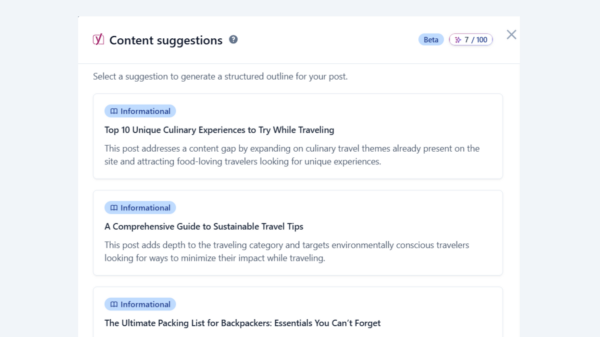
You know you need to publish, but deciding what to write about can sometimes take forever. To help you overcome this, we built the Yoast AI Content Planner. It scans your existing content, identifies gaps, and suggests five relevant blog ideas.
When you open a new post, Yoast SEO analyzes your site’s content and generates ideas tailored to your niche. These aren’t generic suggestions because they’re based on what your audience is already reading and what’s missing from your blog. For example, if you run a food blog and have written about meal prep but not quick vegetarian lunches, that might suggest that topic.
Once you pick an idea, Yoast SEO creates a structured draft with a suggested title, headings, and even a meta description. You get a clear outline so you can start writing immediately. If the first set of ideas doesn’t feel right, you can generate a new batch with one click.
Yoast AI Content Planner is included in all our Yoast SEO Premium products. It’s designed for anyone who writes regularly and wants to publish consistently without running out of fresh ideas. This tool helps you create content that fills real gaps for your audience. Give it a try the next time you’re stuck for ideas.
Dig deeper into your keyword research
Your keyword research document contains many potential blog ideas. But don’t just pick a keyword and start writing, because digging deeper helps you find the best angle.
What’s the search intent behind a keyword? Are people looking for a how-to guide or an opinion piece? Tools like Yoast SEO’s Semrush integration, or Google’s autocomplete can help you figure this out. Don’t forget to check what appears in Google’s AI Overviews or AI Mode answers when you research these keywords and topics.
For example, if your keyword is “best running shoes for flat feet,” ask:
- Are people looking for affordable options?
- Do they care about durability or style?
- Are they comparing specific brands?
Each of these could be its own post:
- “Best budget running shoes for flat feet in 2026”
- “Most durable running shoes for flat feet (tested and reviewed)”
- “Nike vs. Brooks: Which running shoes are best for flat feet?”
This way, you’re not simply writing about a keyword, but answering the exact question your audience is asking. Plus, if you set up Wincher in Yoast SEO, you can track how well your posts perform for these keywords over time.
Finding ideas for blog posts on the internet
Pinterest is still a useful place to find inspiration, especially if your blog covers visual topics like food, DIY, fashion, travel, or home decor. But it’s not just for pretty pictures, because you can use it to spot trends and gaps in your niche. Search for keywords such as [blog post ideas], [blog ideas], or [what to blog about]. To get even more inspiration fast, include your niche in your search. For example: [blog post ideas for parents], or [blog post ideas for lifestyle bloggers]. Be sure to check the top-pinned post for the topics.
It’s a good idea to be cautious as well, because Pinterest is clickbait heaven. Falling into the trap of quantity over quality is easy. Keep your focus, or you’ll lose track of time.
Content Idea Generator
To be clear, the Content Idea Generator won’t give you ready-to-go article ideas. At best, it will point you in the right direction; at worst, it will provide you with a few good laughs to clear your head. For example, you can enter the term [house plant]. Content Idea Generator could give you the following title: ‘The 15 biggest house plant blunders’. A content idea about [wine]: ’17 unexpected uses for wine’. Enter [baby] and a suggestion that might come up: ‘20 ideas you can steal from babies’.
So, while the Content Idea Generator won’t give you what you want immediately, it’s sure to get your creativity flowing. Taking the previous examples, you could expand on that and get the following blog ideas:
- ‘The 15 biggest house plant blunders’: a post about common mistakes people make when caring for the plants in their homes
- ‘17 unexpected uses for wine’: a post about using wine for cooking, cleaning, baking, etc.
- ‘20 ideas you can steal from babies’: could inspire a blog post about babies’ habits adults should adopt, such as getting enough sleep, dressing up warmly, expressing your emotions, etc…
Use AI and chatbots for inspiration
AI tools and chatbots like ChatGPT, Claude, or Gemini can help when you’re stuck. But don’t just ask for generic ideas, and always provide context about your blog and your audience. Here’s how to get the most out of them:
Ask for specific angles, so instead of “Give me blog ideas about parenting,” try:
- “What are five unique angles on ‘screen time for toddlers’ that most blogs miss?”
- “What are three common mistakes new bloggers make when writing about SEO?”
Always try to refine vague ideas, so if you have a broad topic, ask AI to narrow it down. For example:
- “Give me five blog post ideas about ‘healthy snacks for kids’ that aren’t just recipes.”
- “What are three easy-to-apply SEO tips for small e-commerce stores based in India?”
Reverse-engineer competitors by feeding AI a competitor’s blog URL and asking:
- “What gaps does this blog have? Give me five post ideas they haven’t covered.”
- “What are three topics this blog covers poorly? How could I do them better?”
Try to avoid producing commodity content, because AI often suggests ideas that feel generic or overdone. Always add your own perspective, your experience, or data, as this can truly make your content stand out from the crowd. For example, if AI suggests “10 tips for better sleep,” make it unique:
- “The science behind sleep: What actually works, according to research”
- “How I improved my sleep in 30 days (with data)”
- “Why most sleep tips don’t work for parents (and what to try instead)”
Days Of The Year
Days Of The Year is a website that offers inspiration for all kinds of blogs. This website collects all the fun, bizarre, and nice holidays the world has to offer. You can easily lose a couple of hours while scrolling through that site. Keep your pen and notepad at hand, though, because it is bound to give you tons of inspiration. There are days available for every niche. Are you a fan of mythical creatures? April 9th is ‘Unicorn Day’. There’s also a ‘Leprechaun Day’ and a ‘Howl at the Moon Day’. May 25th is ‘Towel Day’, which can give travel bloggers and lifestyle bloggers ideas for posts. Think of blog posts such as: ‘How to keep your towels soft’ or ‘With this information you will never buy the wrong towel again’.
Other blogs and fellow bloggers
The internet is full of inspiration for blog ideas, and there are many places to look. Perhaps you follow other bloggers who inspire you. A great way to come up with blog post ideas is to read other posts or just scroll through post feeds. Similarly, you can join Facebook groups related to your niche or for bloggers. Discussing ideas with fellow bloggers will surely get your creative juices flowing! Make sure you do not copy people’s ideas, though, and give credit where credit is due.
Get blog post inspiration from your life
Current events
Current events can give you great blog ideas if you connect them to your niche. The trick is to link the news to what your audience cares about in a way that feels natural. For example, if you run a parenting blog, a new study on screen time could inspire a post like “How much screen time is too much? What the latest research says.” If you write about personal finance, a change in tax laws might lead to “Three ways the new tax rules affect your savings (and what to do about it).” The key is to add value, so don’t just repeat the news, but explain what it means for your readers.
Set up Google Alerts for keywords related to your topic to stay updated. When something relevant pops up, think about how it affects your audience. For instance, if you blog about sustainable living, a new recycling policy could lead to a post titled “How to adjust your recycling habits under the new rules.” Avoid sensitive topics unless you can handle them thoughtfully. If you do cover them, focus on helping your readers, not just exploiting the trend. The goal is to turn news into high-quality content that fits your blog’s purpose.
Your daily life
Situations from your own work could also be great inspiration for blog posts. You can write about things that happen in your day-to-day life, and how you go about them. Or even about what you do if your clients or colleagues are faced with a certain problem. It’s quite possible that others encounter the same problem and are seeking input.
If you write about real-life situations, you should always make sure that you respect the privacy of your clients, friends, or colleagues and ask for permission to use their cases on your blog. For example, a therapist with a blog offering mental health tips might want to use examples from their practice. In that case, it’s vital to change names and details to protect clients’ privacy and the practice’s future!
Clear your head to find fresh ideas
Sitting at your desk for too long can drain your creativity. If you’re staring at a blank screen, step away and do something that shifts your focus. A short walk, or even washing the dishes, can help reset your mind. The goal isn’t to force ideas but to give your brain space to wander. Often, the best thoughts come when you’re not trying too hard.
If you need a more structured break, try a ten-minute brainstorming sprint. Set a timer and ask yourself: “What are twenty blog ideas about [your topic]? Make five weird, five practical, and ten in between.” Don’t overthink it and just write down whatever comes to mind. When the timer goes off, pick the most interesting idea and freewrite about it for another five minutes. This exercise forces you to think outside your usual patterns and often leads to unexpected angles. When you return to your desk, you’ll likely feel more focused and inspired.
Keep a list of ideas
The solution can be very simple: some days, you have plenty of blog post ideas, some days you don’t. So, prepare for days when you have no inspiration and keep a list of blog ideas. It doesn’t matter whether it’s a list on your mobile phone or on paper. Every time you have a good idea, write it down. You can use these ideas on days you’re feeling uninspired.
Wrap up with fresh ideas
Don’t let a lack of inspiration derail your publishing schedule. Whether you use Yoast AI Content Planner or take a break to clear your head, there are always ways to find new topics. The best approach combines structure and creativity, using tools to generate ideas, then refining them with your own insights and voice.
The next time you’re stuck, pick one method from this list and give it a try. Maybe it’s deep-diving into your keyword research or setting a timer for a quick brainstorming session. Each of these strategies can help you break through writer’s block and keep your content flowing.
Keep reading: SEO copywriting: the ultimate guide »
The post How to get blog post ideas: Tips to find inspiration appeared first on Yoast.